
Mansions of Madness
A tabletop strategy game of Lovecraftian horror and mystery.
Mansions of Madness is a tabletop strategy game that first appeared in 2011. Corey Konieczka designed it, and Fantasy Flight Games published it. The game sends players into a location crawling with Lovecraftian nightmares, where they must solve a mystery. After five years, the original version was discontinued and replaced by a second edition. That new edition came from designer Nikki Valens and swapped out the human player who ran the game for a companion app.
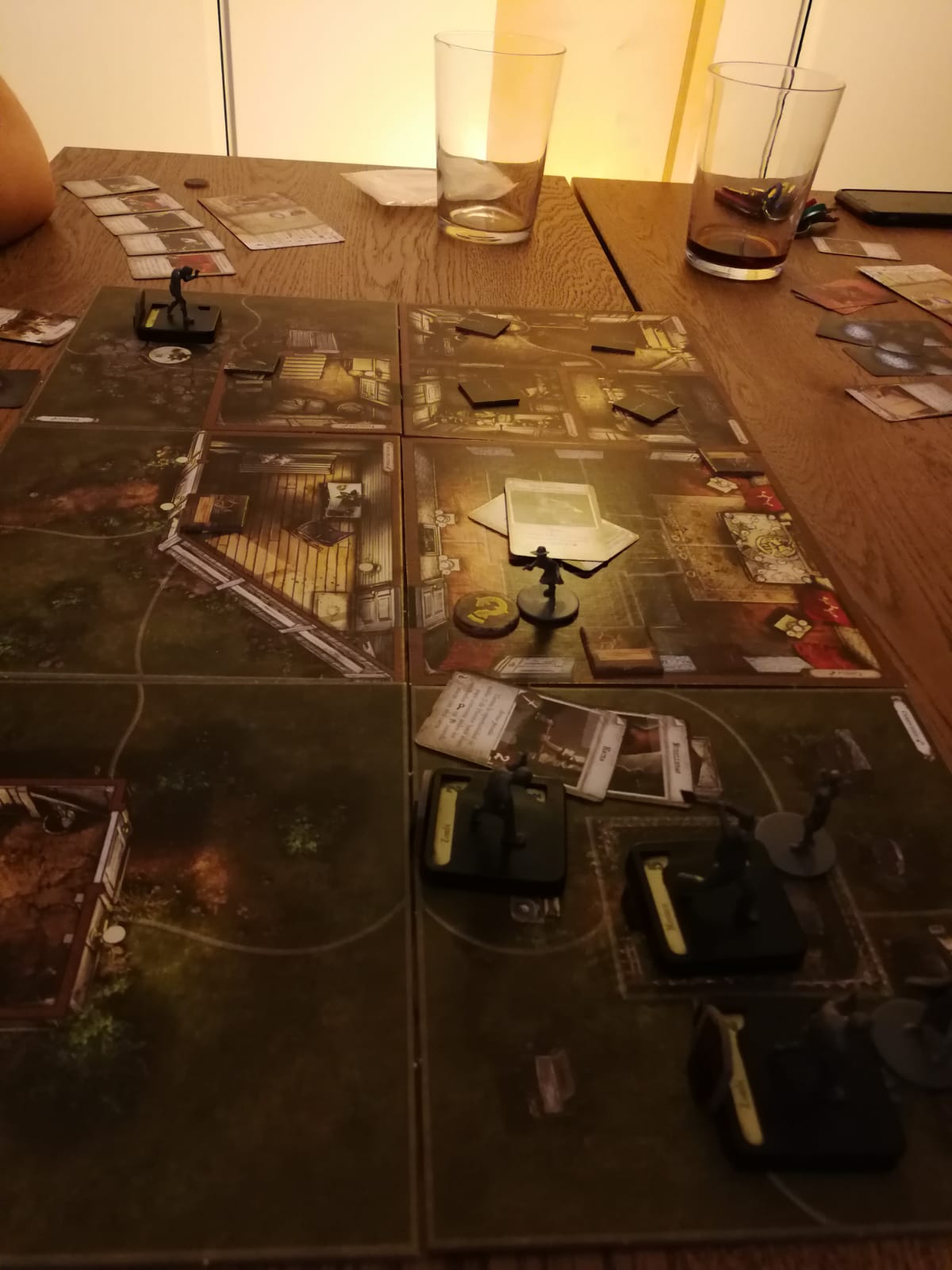
In the first edition, two to five people could play. One person acted as the keeper, controlling the monsters and events. The rest were investigators trying to crack the case. Players picked a storyline and set up the board accordingly. The keeper used the rulebook to decide how the story unfolded and where to put clues and traps. Once everything was ready, the investigators started at a designated spot. If the scenario had a main character, that player went first; otherwise, the youngest player did. After that, the other explorers took turns. Each investigator could move two spaces and do one action. Every character had health and sanity scores that dropped when they got hurt or scared. Whenever an investigator took damage, the keeper could play trauma cards that added extra penalties—like a broken leg that slowed movement or nyctophobia from facing an eldritch horror. During an investigator’s turn, the keeper could play mythos cards to hurt them physically or mentally, wreck their items, or otherwise slow them down. After all investigators finished their turns, the keeper got to react. Each turn, the keeper gained threat points equal to the number of investigators, which were needed to use most of the keeper’s ability cards. The keeper knew the objective from the start, but the investigators only learned it near the end.
Two big-box expansions came out for the first edition. Forbidden Alchemy, also designed by Konieczka, released in 2011. It added three new scenarios: Return of the Reanimator, Yellow Matter, and Lost in Time and Space. It also brought four new investigators (Carolyn Fern, Dexter Drake, Darrell Simmons, and Vincent Lee), four new monsters (two byakhees and two crawling ones), six new map tiles, and extra cards and tokens. A revised printing in May 2012 fixed some cards and map setups for all three scenarios. Call of the Wild, again by Konieczka, came out in 2013. It included five n
- Publisher
- Fantasy Flight Games
- First Edition Designer
- Corey Konieczka
- Second Edition Designer
- Nikki Valens
- First Edition Release Year
- 2011
- Second Edition Release Year
- 2016
- Player Count
- 2 to 5
- Genre
- Tabletop strategy game with Lovecraftian horror
Lore & Background
Mansions of Madness first edition requires two to five players. One player takes the role of the keeper, who is responsible for the monsters and happenings; the other players are investigators solving a mystery. Players pick a storyline and set up the map accordingly. The keeper consults the rule book to place clues and traps. Investigators move two spaces and carry out one action per turn, with health and sanity values depleted by damage. The keeper may play trauma cards and mythos cards to hinder investigators. The keeper accumulates threat points equal to the number of investigators each turn, used for ability cards. The keeper knows the objective from the beginning; investigators learn it near the end.
Two expansions were published for the first edition: Forbidden Alchemy (2011) and Call of the Wild (2013), both designed by Corey Konieczka. Forbidden Alchemy included three new scenarios, four investigators, four monsters, and six map tiles. Call of the Wild included five new scenarios, four investigators, eleven monsters, and eleven map tiles, shifting focus to outdoor settings and introducing allies and non-player characters. Six print-on-demand scenarios were released separately between 2011 and 2013.
Reader's Guide
Mansions of Madness Second Edition, released on 4 August 2016, replaced the keeper role with a companion app running on Steam (Mac or PC), Apple iOS, or Android. The app randomizes maps and monsters and incorporates interactive puzzles, and allows solo play. The second edition came with a conversion kit for first edition components. Shortly after, two figure and tile collections—Recurring Nightmares and Suppressed Memories—were released to make first edition components available to new players. The base game included four scenarios and three DLC scenarios; owning first edition components unlocked additional scenarios.
Three expansions followed: Beyond the Threshold (January 2017), Streets of Arkham (fourth quarter 2017), and Sanctum of Twilight (first quarter 2018). These added investigators, monsters, map tiles, tokens, cards, and new scenarios. The game's significance lies in its evolution from a human-run keeper system to an app-driven experience, expanding accessibility and replayability while maintaining the core investigative horror gameplay.
Did You Know?
- The first edition was designed by Corey Konieczka and published in 2011.
- The second edition replaced the human keeper role with a companion app.
- Two big-box expansions for the first edition were Forbidden Alchemy (2011) and Call of the Wild (2013).
- Six print-on-demand scenarios were released for the first edition between 2011 and 2013.
The Keeper's Burden and the Investigators' Quest
Mansions of Madness, designed by Corey Konieczka and published by Fantasy Flight Games in 2011, built its identity around an asymmetric structure: one player serves as the keeper while two to five others play investigators. The keeper holds the objective from the very start, consulting the rulebook to place clues, traps, and story beats across a modular map, while the investigators remain unaware of the true goal until late in the session. Each investigator turn allows two spaces of movement and one action, but the real tension comes from the keeper's reactive phase. The keeper accumulates threat points equal to the number of investigators each round, spending them to deploy ability cards. When an investigator takes damage, the keeper can layer on trauma cards—inflicting a broken leg that slows movement or a condition like nyctophobia born from an eldritch encounter. Mythos cards add another layer, threatening physical harm, mental degradation, or the loss of equipment. This push-and-pull between hidden narrative and player agency defined the first edition's appeal.
Expanding the Horror – First Edition Add-Ons
The first edition's content library grew substantially through two major expansions and a series of standalone scenarios. Forbidden Alchemy, also designed by Konieczka and released in 2011, added three scenarios—Return of the Reanimator, Yellow Matter, and Lost in Time and Space—along with four new investigators, four monsters including byakhees and crawling ones, and six new map tiles. A revised printing in May 2012 corrected card and map setup issues across all three scenarios. Call of the Wild, released in 2013, marked a deliberate shift toward outdoor, less linear environments that gave players greater freedom in exploration. It introduced five scenarios, four additional investigators, eleven monsters ranging from dark druids to the Dunwich Horror, and eleven new tiles. Notably, it brought in allies, non-player characters, and puzzle-solving duties for the keeper. Beyond these, Fantasy Flight released six print-on-demand scenarios between 2011 and 2013, including Season of the Witch, The Silver Tablet, and The Yellow Sign, extending the game's narrative reach well beyond the base box.
The Digital Turn – Second Edition and the App
After five years of active play, two major expansions, and six print-on-demand scenarios, the original Mansions of Madness was retired. Its replacement, Mansions of Madness Second Edition, launched on 4 August 2016 under the design of Nikki Valens. The most visible change was the elimination of the human keeper role, replaced by a companion app available through Steam on Mac or PC, Apple iOS, or Android. Core gameplay remained fundamentally similar, but the app introduced meaningful expansions: randomized map and monster placement, a broader range of interactive puzzles, and the ability to play solo. The base game shipped with four scenarios of varying length and difficulty, plus three additional scenarios gated behind downloadable content. A conversion kit let owners of the first edition base game and either expansion plug their existing investigator figures, monster figures, and map tiles into the second edition, adding variety and unlocking bonus scenarios. This hybrid approach of physical components meeting digital orchestration set a template for future board-game design.
Preserving the Past – Component Continuity and Collections
With first-edition production ceasing, Fantasy Flight faced the challenge of keeping its extensive component library accessible. The solution was two figure and tile collections—Recurring Nightmares and Suppressed Memories—released shortly after the second edition's launch. These were not true expansions but rather re-packagings of the old, out-of-production first-edition components, allowing new players without the original game to add those investigators, monsters, and tiles to their second-edition experience. Owning either the first-edition base game or the Recurring Nightmares collection unlocked one additional scenario, while owning Call of the Wild or Suppressed Memories unlocked another. The conversion kit that shipped with the second edition base game served a similar purpose for existing first-edition owners, letting them integrate their physical pieces into the app-driven system. This layered approach ensured that the five years of accumulated content—from the original box through both expansions and the six standalone scenarios—remained playable and relevant, bridging the gap between the keeper-driven era and the app-driven one.
Gallery
More in Horror board games 1-19
Spotted an error? Know more?
This is a living reference — every entry is fact-audited, and reader corrections feed straight into our audit queue. Suggest an edit · See this site's audit record