
Green Ghost
First board game designed to be played in the dark.
Green Ghost is a board game for up to four players that debuted in 1965 from Transogram. It holds the distinction of being the first board game specifically made to be played in the dark.
Transogram produced the game in large numbers in 1965, later selling its toy division to Marx Toys in 1970. In Australia, the Ideal Toy Company handled distribution. Marx Toys issued a 30th Anniversary edition in 1997 (item #3905), with a box reading "Find Kelly the Ghost... if you DARE." The game remains a collector's item, though the many different editions make it hard for collectors to confirm a complete set.
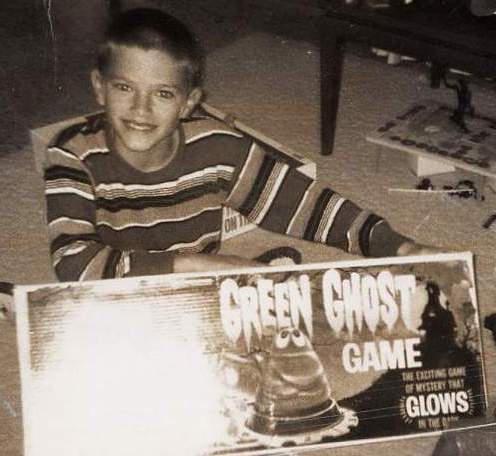
Original TV ads urged players to play in the dark. The 1965 box bore the strapline "THE EXCITING GAME OF MYSTERY THAT GLOWS IN THE DARK."
The central character was modeled on The Blob, and the design leaned into the campy horror style of shows like *The Addams Family*. The three-dimensional board, made of luminous plastic, sits on six stilts and depicts a spooky town with winding paths around three scenes. Underneath are three boxes covered by locked trapdoors, representing pits. Each pit holds plastic bones, "bat" feathers, or rubber snakes, plus several hidden "ghost kids" (one named "Kelly," the Green Ghost's child). Paths wind around the pits, with regular spaces, spaces showing a "pet" (player pawn), and holes leading into the pits.
To set up, four ghost kids go into each pit. Other items add texture when a player reaches in: snakes in the shipwreck pit, bones in the haunted house pit, and feathers in the gnarled tree pit. Each player picks a pawn—vulture, rat, cat, or bat. Keys are mixed and hidden under the board; each player draws one at random. Keys unlock trapdoors to collect ghost kids. With fewer than four players, leftover keys stay under the board. Players place their pawn on any regular space (not a pawn-picture space). The youngest player goes first.
On a turn, the player spins the large Green Ghost to see how many spaces to move. Movement can be in any direction. If a player (A) lands on a space showing another player’s (B’s) pawn, A and B may exchange keys. A can decline, but if A requests the exchange, B must agree. Since there are four keys and three pits, one key is a "misfit" that opens no pit. Landing on a hole makes a player "vanish" and "reappear" at the pit matching their key. They unlock that pit, reach in, and take one ghost kid. Th
- first_published
- 1965
- publisher
- Transogram
- field
- Board game
- known_for
- First board game designed to be played in the dark
Lore & Background
Transogram mass-produced Green Ghost in 1965, then sold its toy interests to Marx Toys in 1970. In Australia, the game was distributed by the Ideal Toy Company. In 1997 Marx Toys produced a 30th Anniversary edition of the game (MCMXCVII, Item #3905), with the box printing 'Find Kelly the Ghost... if you DARE'.
Reader's Guide
Green Ghost remains collectible, but with so many different editions it is difficult for collectors to know if they have a complete set. The game's central character was modeled on The Blob and the design aimed at the campy horror genre of shows like The Addams Family. The three-dimensional board features standing scenery and is designed to appear as a spooky town with winding paths surrounding three scenes. The luminous plastic board is elevated on six stilts with three boxes underneath, covered by locked trapdoors, representing pits containing plastic bones, 'bat' feathers, or rubber snakes, plus hidden 'ghost kids'. Gameplay involves players moving pawns (vulture, rat, cat, or bat) around the board, exchanging keys, and retrieving ghost kids from pits. The game ends when all twelve ghost kids have been retrieved, and the player who collected the fewest spins the Green Ghost to identify which ghost kid is Kelly; whoever found that one wins.
Did You Know?
- Green Ghost is the first board game designed to be played in the dark.
- The central character was modeled on The Blob.
- The 1965 box has the printed strapline 'THE EXCITING GAME OF MYSTERY THAT GLOWS IN THE DARK.'
- In 1997 Marx Toys produced a 30th Anniversary edition with the box printing 'Find Kelly the Ghost... if you DARE'.
Origins & Publication History
Green Ghost entered the board game world in 1965 when Transogram mass-produced what would become a genuinely unique product: the first board game specifically engineered for play in complete darkness. The title supports up to four players and was conceived as a tactile, sensory experience rather than a traditional tabletop strategy game. Transogram handled initial manufacturing and distribution, but the company's toy division was eventually sold to Marx Toys in 1970, shifting the brand's stewardship to a new corporate home. In the Australian market, the game found its audience through the Ideal Toy Company, which handled local distribution. Decades later, in 1997, Marx Toys marked the title's three-decade milestone with a special 30th Anniversary edition, catalogued under the code MCMXCVII and item number 3905. That commemorative box carried the playful taunt "Find Kelly the Ghost... if you DARE," a nod to the game's original spooky charm while appealing to a new generation of buyers.
Design & Aesthetic Vision
The visual identity of Green Ghost draws directly from the campy horror aesthetic of 1960s television. The central character was modeled on The Blob, and the overall tone evokes shows like The Addams Family, positioning the game squarely in the lighthearted spookiness of that era. The board itself is a three-dimensional structure built from luminous plastic, elevated on six stilts to create a raised platform. Standing scenery gives the impression of a spooky town, with winding paths that loop around three distinct scenes. Beneath the elevated surface sit three boxes sealed behind locked trapdoors, each representing a pit. These pits are stocked with tactile fillers: plastic bones for the haunted house pit, rubber snakes for the shipwreck pit, and "bat" feathers for the gnarled tree pit. Hidden among these textures are the "ghost kids," small figures one of whom is Kelly, the Green Ghost's child. The paths connecting the scenes include regular spaces, spaces marked with pictures of player pawns, and open holes that drop a player into the pit below.
Gameplay Mechanics
Each player chooses a creature pawn—vulture, rat, cat, or bat—and draws one of four keys hidden beneath the board. Three keys unlock the three pits; the fourth is a deliberate "misfit" that opens nothing. On a turn, a player spins the large Green Ghost figure to determine how many spaces to move, traveling in any direction. Landing on a space bearing another player's pawn image triggers a key-exchange negotiation: the landing player may demand a swap, and the other must comply. Stepping onto a hole sends the player "vanishing" to reappear at the pit matching their key. They must unlock it, reach into the textured pit, and pull out one ghost kid. Afterward, they place their pawn on a picture space and are required to exchange keys. Once all twelve ghost kids are collected and slotted into small holes on the spinner, the player who gathered the fewest spins the Green Ghost one final time. It points to a specific ghost kid identified as Kelly, and whoever holds that figure wins.
Collectibility & Cultural Footprint
Green Ghost has maintained a steady presence in the board game collecting world despite the passage of decades. Its original 1965 box carried the strapline "THE EXCITING GAME OF MYSTERY THAT GLOWS IN THE DARK," a tagline that television commercials reinforced by explicitly encouraging players to extinguish the lights. That dark-play instruction was not a suggestion but a core design intent, making the game a novelty sensation in its era. However, the very longevity and multiple re-releases that kept Green Ghost in circulation have created a headache for dedicated collectors. With so many different editions produced over the years—spanning Transogram's original run, Marx Toys' 1970s and 1990s releases, and the Ideal Toy Company's Australian distribution—it is genuinely difficult for a collector to determine whether they possess a truly complete set. The 1997 30th Anniversary edition, with its distinctive box art, adds yet another variant to an already complex catalog, ensuring the game remains a subject of ongoing discussion among hobbyists.
Gallery

More in Horror board games 1-19
Spotted an error? Know more?
This is a living reference — every entry is fact-audited, and reader corrections feed straight into our audit queue. Suggest an edit · See this site's audit record